






How Long Does Weed Smell Last Outside? The Quick Answer

How quickly does cannabis odor dissipate in an outdoor environment? Under favorable conditions with adequate outdoor air circulation, marijuana smoke typically clears within 20-30 minutes. Wind speed serves as the primary variable, breezes of 3-5 mph accelerate terpene dispersion dramatically compared to stagnant conditions.
When you’re dealing with still air, expect cannabis odor to linger 1-2 hours or longer. Humidity compounds this effect; moisture-laden air causes volatile organic compounds to cling stubbornly rather than disperse. In sheltered spots with minimal airflow, detection remains possible for 6-8 hours. The strain’s terpene profile also influences how long the scent persists, as some cannabis varieties produce more pungent aromatic compounds than others.
Your location matters considerably. Open spaces with consistent wind patterns clear fastest, while semi-enclosed areas like courtyards trap aromatic compounds. Dry, breezy conditions represent ideal scenarios for rapid clearance, reducing detectable odor to mere minutes rather than hours. In breezy outdoor conditions, the smell may fade significantly within just a few hundred feet from the source. For comparison, indoor spaces without proper ventilation can retain cannabis odor for 12-48 hours, making outdoor consumption far more discreet when privacy is a concern.
Your location matters considerably. Open spaces with consistent wind patterns clear odors fastest, while semi-enclosed areas like courtyards tend to trap aromatic compounds, highlighting how to get rid weed smell more effectively through airflow rather than masking. Dry, breezy conditions are ideal for rapid clearance, often reducing detectable odor to mere minutes instead of hours. In such outdoor settings, the smell may fade significantly within just a few hundred feet from the source. By comparison, indoor spaces without proper ventilation can retain cannabis odor for 12, 48 hours, making outdoor consumption far more discreet when privacy is a concern.
Why Open Air Clears Weed Smell in Under 30 Minutes
When you’re outdoors, wind creates turbulent air currents that rapidly dilute terpene concentrations, carrying volatile compounds away from the source before they can accumulate to detectable levels. Natural airflow physically disperses smoke particles through mechanical diffusion, breaking down the concentrated plume into progressively smaller molecular clusters that fall below your olfactory threshold. Open spaces lack the surfaces and enclosures that trap odor molecules, so there’s no opportunity for the characteristic cannabis terpenes to adsorb onto materials and re-release over time. Additionally, sunlight and air movement work together to gradually break down odor molecules, accelerating the dissipation process in outdoor settings. The potency of the cannabis strain also influences how quickly the smell disappears, as higher-potency varieties release more concentrated terpenes into the air. In contrast, indoor environments without proper ventilation can retain the pungent, skunky aroma for several hours because enclosed spaces allow odor molecules to settle into fabrics and surfaces.
Wind Accelerates Odor Dispersion
Because wind velocity directly governs the rate at which volatile terpenes and sulfur compounds disperse from a combustion point, understanding air movement patterns is essential for predicting outdoor odor persistence. Wind speed determines how rapidly ambient air movement dilutes aromatic molecules, with moderate breezes pushing cannabis odor 100 to 150 feet from the source. Wind direction dictates which zones experience exposure, making airflow patterns critical variables in dispersal calculations. Downwind areas experience significantly greater detectability compared to equivalent distances in other directions. The characteristic “skunky” smell results from alpha-linolenic acid breakdown when cannabis compounds are exposed to UV light, contributing to the distinctive odor profile that disperses through outdoor environments. Research indicates that thiols are the sulfurous compounds primarily responsible for the skunky odor commonly associated with mature cannabis plants.
- Light breezes confine detectable odor within 10 to 20 feet on calm days
- Strong winds carry scent 300 to 400 feet across open terrain
- Steady airflow can drift odor across entire parks or city blocks
- Open space vs enclosed space dramatically affects dispersion rates
You’ll notice odor dissipates fastest when consistent airflow prevents molecular accumulation near combustion sources.
Natural Airflow Breaks Particles
Why does cannabis odor vanish so rapidly in open air? Natural airflow serves as the primary mechanism driving particle fragmentation of volatile terpene compounds. When you’re outdoors, air molecules continuously collide with cannabis smoke particles, physically shearing molecular bonds and breaking down odor-producing compounds into non-detectable fragments.
Temperature plays a critical role in this process. Heightened molecular kinetic energy accelerates terpene volatilization, with compounds like myrcene dissipating within 10-20 minutes under ideal conditions. Warmer temperatures above 20°C effectively halve your airborne linger time compared to cooler environments.
Humidity also influences clearance rates. Moisture binds to terpene molecules, increasing particle weight and promoting faster ground deposition. This coalescence effect typically clears suspended particles within 15-25 minutes. In contrast, dry conditions cause smoke particles to remain suspended longer, extending the time needed for complete odor dispersal. Combined with UV-driven photo-oxidation, these atmospheric processes guarantee cannabis odor rarely persists beyond 30 minutes outdoors. Wind direction and airflow patterns determine how quickly these dispersed particles move away from the source location, further accelerating the clearance process. For medical cannabis patients who need to maintain discretion, understanding these outdoor clearance timeframes can help alleviate anxiety about odor detection.
Open Spaces Prevent Accumulation
Most open-air environments eliminate detectable cannabis terpenes within 20-30 minutes due to multidirectional airflow patterns that prevent molecular accumulation. When you’re in open air settings like fields or parking lots, outdoor ventilation works through natural convection currents that continuously displace volatile compounds.
Atmospheric dispersion in unobstructed spaces follows predictable patterns:
- Air dilution occurs exponentially as terpene molecules spread across expanding surface areas
- Odor dispersion accelerates when no structural barriers redirect or trap aromatic compounds
- UV photodegradation breaks down myrcene and limonene faster in exposed environments
- Cross-ventilation from multiple directions prevents localized concentration buildup
- Terpenes are volatile, meaning they evaporate quickly and disperse into the surrounding atmosphere with ease
You’ll notice that vast outdoor areas don’t allow the stagnant pockets where cannabis aromatics typically linger. The absence of walls means volatile organic compounds can’t accumulate at detectable thresholds, ensuring rapid clearance regardless of initial emission intensity.
Why Porches and Patios Hold Weed Smell for Hours
Semi-enclosed outdoor spaces like porches and patios create microenvironments where cannabis terpenes persist far longer than they’d survive in open air. Air flow limitations in these sheltered zones prevent rapid dispersion, allowing volatile compounds to linger 6-8 hours under still conditions.
Porous surfaces compound the problem immensely. Concrete, wood decking, and fabric cushions act as terpene reservoirs, with absorbed terpenes releasing gradually over extended periods. Humidity and weather conditions further influence retention, calm, humid days amplify molecular adhesion to materials.
Strain and quantity factors determine severity. High-terpene cultivars like Lemon Skunk or myrcene-dominant varieties embed stubbornly in patio furnishings for 12-24 hours. Larger quantities exceeding 5 grams produce correspondingly persistent odor profiles. You’ll find these semi-enclosed environments fundamentally function as odor traps, requiring active ventilation to accelerate clearance.
Strain and quantity factors determine severity. High-terpene cultivars like Lemon Skunk or myrcene-dominant varieties, often categorized among the seven distinct scents of weed, can embed stubbornly in patio furnishings for 12, 24 hours. Larger quantities exceeding 5 grams produce correspondingly more persistent odor profiles. In these cases, semi-enclosed environments effectively function as odor traps, requiring active ventilation to meaningfully accelerate clearance.
When Outdoor Weed Smell Sticks Around Longer Than Expected
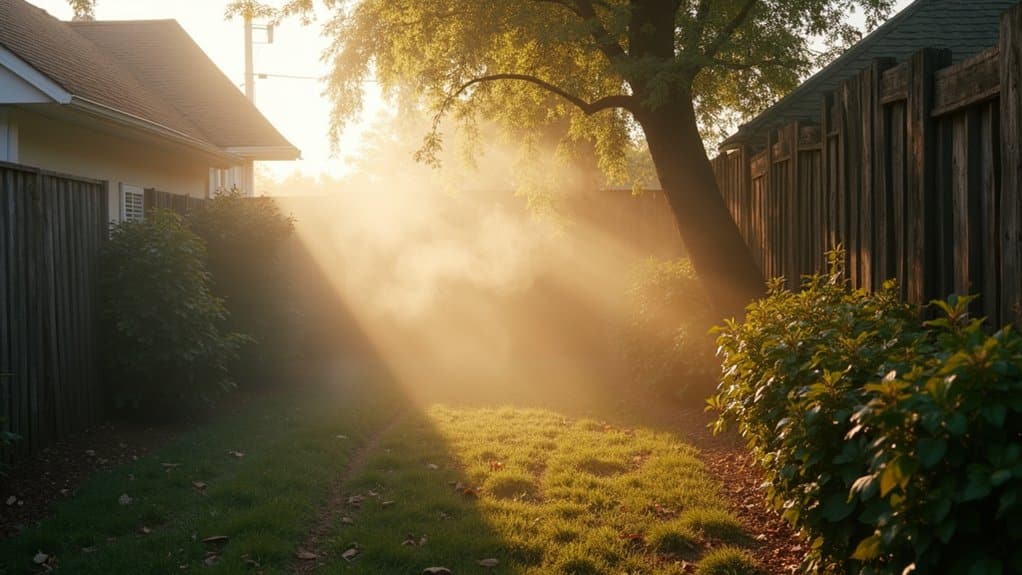
How exactly does a brief outdoor session leave you smelling like a dispensary hours later? Environmental factors affecting odor persistence work against you when outdoor ventilation effectiveness drops. Strains rich in myrcene and β-caryophyllene release heavier terpene molecules that resist rapid dispersal. These combustion byproducts don’t just vanish, they exploit surface adherence on your clothing and hair.
Your olfactory perception adapts quickly, masking how intensely you’ve absorbed the scent. Meanwhile, terpenes embed into fabric fibers for days. Warmer temperatures cause cannabis to release more aromatic oils, intensifying the odors that cling to you. Improper storage or prolonged ageing of cannabis can also degrade these terpenes, altering both the smell profile and how long odors persist in outdoor environments.
- Heavy winter jackets trap odor compounds for weeks without washing
- Hair retains smell 1-2 days even with outdoor exposure
- Sheltered patios extend persistence to 6-8 hours minimum
- Larger quantities (5+ grams) maintain detectable presence for 12-24 hours
Still air and high humidity compound these effects dramatically.
How Wind, Rain, and Humidity Change Weed Smell Duration
When you’re evaluating how long cannabis odor persists outdoors, you’ll find that wind velocity, precipitation, and relative humidity function as the primary environmental modulators of terpene dispersal. Wind accelerates the dilution of volatile compounds across larger airspace, rain initially intensifies odor release from wet plant material before washing airborne molecules from the atmosphere, and humidity creates a dual effect by enhancing terpene volatility while simultaneously prolonging their suspension in moisture-laden air. Understanding these three variables helps you predict whether outdoor cannabis aroma will dissipate in minutes or linger for hours. The intensity of the smell you’re trying to disperse also depends on factors like whether you’re smoking joints versus using consumption gear like bowls, bongs, and vapes, which can minimize the strength of the odor from the start. In certain environments, there may be additional causes of hay like weed smell that can be attributed to nearby vegetation or soil composition. For instance, particular grasses or plants could emit similar aromatic compounds, making it challenging to pinpoint the source of the odor. Moreover, factors such as recent landscaping or agricultural activities might also contribute to these overlapping scents in the air.
Wind Accelerates Odor Dispersal
Because wind speed directly governs how rapidly volatile organic compounds disperse from a cannabis source, understanding airflow dynamics proves essential for predicting outdoor odor duration. When you’re cultivating or consuming outdoors, even a light breeze of 3-5 mph accelerates scent evaporation and smoke particles breakdown by over 50% compared to still conditions.
Wind affects your odor plume through several mechanisms:
- Terpene volatility increases as airflow strips molecules from surfaces and clothing
- Heavier smoke particles disperse slower than lighter vapor compounds in identical wind conditions
- Odor plume direction shifts with wind, carrying compounds toward or away from detection zones
- Continuous ventilation prevents molecular accumulation near the source point
You’ll notice that positioning yourself downwind during sessions markedly reduces localized odor concentration and detection risk.
Rain Intensifies Then Clears
While wind remains the dominant factor in outdoor odor dispersal, precipitation events introduce a more complex two-phase pattern that cultivators and consumers must understand. Rain initially intensifies cannabis odor as moisture traps volatile terpenes, myrcene, limonene, and pinene, in suspended water droplets near the source. You’ll notice peak odor detection during active rainfall when humidity levels keep tetrahydrocannabinol-associated compounds concentrated in your immediate vicinity.
Once precipitation clears, dispersal accelerates rapidly. Post-rainfall breezes typically eliminate detectable odor within 20-30 minutes under favorable conditions. However, still-air environments extend persistence to 1-2 hours. Semi-enclosed cultivation areas present greater challenges, retaining scent profiles for 1-3 hours with adequate circulation or 6-8 hours in sheltered zones. You should plan outdoor activities around these weather-dependent timelines to minimize detection concerns.
Humidity’s Dual Effect
Humidity exerts a paradoxical influence on cannabis odor persistence, simultaneously enhancing molecular dispersion while extending detection windows. When relative humidity exceeds 60%, you’ll notice terpene compounds travel farther as moist air carries these aromatic molecules more effectively than dry conditions.
This dual mechanism affects your outdoor cultivation in specific ways:
- Enhanced dispersion: Humid air enables odor molecules to spread across greater distances, increasing detection radius
- Extended persistence: Moisture traps volatile terpenes, prolonging airborne duration by 10-20 minutes
- Intensified detection: Your nasal receptors respond more acutely to odors in warm, humid environments
- Reduced airflow efficiency: High humidity diminishes wind’s dispersal effectiveness
You’ll find that humidity above 60% RH creates favorable conditions for odor detection while simultaneously slowing complete clearance. Adequate airflow becomes critical to counteract humidity’s persistence-enhancing properties.
How Far Can Weed Smell Travel Outside?
When you’re cultivating cannabis outdoors or consuming in open environments, understanding odor dispersal mechanics becomes essential for managing detection risk.
Wind Speed and Atmospheric Variables
Wind speed serves as the primary determinant of terpene travel distance. Under calm conditions, volatile compounds remain localized within 10-20 feet. Moderate breezes extend detectability to 25-30 feet, while sustained winds push aromatic molecules 300-400 feet from the source. Temperature influences evaporation rates of myrcene and limonene, accelerating dispersal in warmer conditions.
Wind speed dictates everything, calm air keeps terpenes close, while steady breezes carry cannabis aromas hundreds of feet from their source.
Terrain and Structural Considerations
Open spaces like fields and parking lots allow omnidirectional scent migration without obstruction. Physical barriers, walls, dense vegetation, buildings, create stagnant air pockets that contain odor locally. Urban vs rural environments produce distinct patterns: urban turbulence causes unpredictable bouncing between structures, while rural settings enable faster dissipation across unobstructed terrain.
Do Certain Strains Produce Stronger Outdoor Smell?
Beyond distance calculations, strain genetics fundamentally determine odor intensity at the source. You’ll notice gassy cultivars like Chemdog, Sour Diesel, and GMO Cookies emit substantially more volatile organic compounds (VOCs) than milder varieties. These strains contain heightened caryophyllene concentrations (15-20%) alongside myrcene and limonene, creating that unmistakable skunk odor and fuel-forward profile.
- Cluster A strains produce earthy, woody, herbal aromas that dissipate faster under favorable meteorological conditions
- Cluster B strains release citrus-dominant VOCs with greater pungency and longer detection ranges
- Trace sulfur compounds intensify diesel characteristics but degrade rapidly during outdoor exposure
- Skatole and indole contribute funky, savory notes that persist longer in humid environments
Gas-forward genetics command 15-25% price premiums specifically because their terpene profiles generate more pronounced, longer-lasting outdoor signatures than fruit-dominant cultivars.
Smoking vs. Vaping: Which Weed Smell Fades Faster Outside?
The method you choose, smoking versus vaping, determines both initial odor intensity and outdoor dissipation rates. Smoking generates substantial smoke particulate matter that disperses slowly, while vaporization produces lighter aerosols with reduced terpene concentration.
| Factor | Smoking | Vaping |
|---|---|---|
| Time to clear smell (open air) | 20-120 minutes | 15-45 minutes |
| Odor absorption on surfaces | High | Low |
| Sunlight degradation rate | Moderate | Rapid |
| Temperature inversion impact | Significant trapping | Minimal trapping |
| Detection distance | Several hundred feet | Under 50 feet |
You’ll notice combustion byproducts linger longer during temperature inversion conditions when atmospheric layering traps heavier molecules near ground level. Vaporized cannabinoids undergo faster sunlight degradation due to their volatile molecular structure. Your cultivation environment’s airflow characteristics ultimately determine whether residual odor absorption affects neighboring detection thresholds.
Why Weed Smell Disappear Faster Outside Than Inside
Because outdoor environments lack the enclosed surfaces and stagnant air that trap volatile compounds indoors, cannabis odor dissipates rapidly in open spaces. You’ll notice terpene behavior differs dramatically between settings, volatile monoterpenes like myrcene oxidize and bind to porous materials indoors, while airflow and wind carry these same compounds away within minutes outside.
Key ventilation differences affecting dissipation:
- Environmental conditions: Temperature and humidity influence terpene volatility and dispersal rates
- Odor trapping surfaces: Fabrics, carpets, and furniture absorb cannabinoid-rich smoke particles indoors
- Airflow dynamics: Even light breezes create continuous dilution impossible in enclosed cultivation spaces
- Surface availability: Outdoor environments offer minimal porous substrates for molecular adhesion
You’re dealing with fundamentally different atmospheric physics. Indoor spaces concentrate terpenes against absorbent materials, while outdoor ventilation facilitates rapid compound dilution through natural convection patterns.
If you or a loved one is struggling with marijuana addiction, you don’t have to face it alone. Florida Addiction Resource LLC is here to connect you with trusted treatment providers across Florida. Whether you require cannabis detox treatment programs, residential care, outpatient services, or ongoing recovery support, we’ll help you access the appropriate resources. Ready to take the next step? Contact us at (561) 562-4336 to discover the care that’s right for you.
Frequently Asked Questions
Can Secondhand Weed Smoke Outdoors Cause a Positive Drug Test?
You’re unlikely to test positive from secondhand weed smoke outdoors. Outdoor airflow rapidly dilutes THC concentrations, keeping your systemic absorption minimal. Studies show positive urine tests typically require extreme exposure, sealed, unventilated spaces with heavy smoking for extended periods. Brief outdoor encounters don’t deliver enough cannabinoids to exceed standard immunoassay cutoff thresholds. Your body would need sustained, concentrated inhalation to metabolize detectable THCCOOH levels, which outdoor dispersion patterns effectively prevent.
Is Outdoor Weed Smell Harmful to Pets Like Dogs or Cats?
You should exercise caution, as outdoor cannabis smoke can affect your pets. Dogs possess approximately 300 million olfactory receptors, making them considerably more sensitive to terpenes and particulate matter. Brief exposure during breezy conditions poses minimal risk since dispersion occurs within 20-30 minutes. However, in still air, your cat or dog may inhale PM2.5 particles and THC compounds for 1-2 hours. Watch for lethargy, disorientation, or respiratory distress requiring veterinary evaluation.
Does Sunlight Actually Break Down the Compounds That Create Weed Smell?
Yes, sunlight actively degrades the terpenes responsible for cannabis odor. UV radiation triggers photodegradation of volatile organic compounds like myrcene, limonene, and pinene, breaking their molecular structures and reducing aromatic intensity. You’ll notice odors dissipate markedly faster in direct sunlight, often within 20 minutes, compared to shaded conditions. The process accelerates when you combine UV exposure with airflow, as oxidation works alongside photodegradation to neutralize these volatile terpene compounds more efficiently.
Can Weed Smell Outdoors Trigger Asthma Attacks in Sensitive Individuals?
Yes, cannabis odor can trigger asthma attacks in sensitive individuals. The smoke carries particulate matter and volatile terpenes like limonene and pinene that irritate your airways and induce bronchospasm. You’ll find these compounds mimic pollen allergens, inflaming bronchial tissue even at low concentrations. Wind speeds above 5 mph dilute irritants quickly, but still air prolongs your exposure. Move upwind from the source to minimize your inhalation risk.
What Time of Day Does Outdoor Weed Smell Dissipate Fastest?
You’ll notice outdoor cannabis odor dissipates fastest during midday hours when ultraviolet radiation peaks and thermal convection increases air movement. UV light accelerates terpene photodegradation, breaking down myrcene and limonene within 15-20 minutes. Afternoon conditions typically combine stronger solar exposure with rising thermals, creating ideal dispersion dynamics. Evening and nighttime hours slow dissipation considerably due to reduced UV activity, temperature inversions, and calmer atmospheric conditions that allow volatile compounds to linger near their emission source.