






When you inhale galaxy gas, nitrous oxide floods your brain and immediately blocks NMDA receptors while displacing oxygen from neural tissue. Within seconds, your cerebral blood flow drops, triggering confusion, impaired memory formation, and motor control disruption. The gas also inactivates vitamin B12, which damages myelin sheaths along your spinal cord and peripheral nerves. This demyelination causes numbness, weakness, and potentially permanent neurological deficits, understanding how galaxy gas abuse affects the brain and nervous system reveals critical intervention points.
What Is Galaxy Gas and Why Is It Dangerous?
Galaxy Gas contains 99.9% pure food-grade nitrous oxide (N₂O), a colorless gas that’s identical to the active compound in whippets and NOS products. When you inhale it, you’ll experience a nitrous oxide high feel characterized by rapid NMDA receptor inhibition and a dopamine surge that creates brief euphoria. However, frequent use can lead to dependency, making it crucial to explore recovery strategies for nitrous addiction. These approaches often focus on therapeutic interventions and support groups that help individuals regain control over their lives.
The danger lies in oxygen deprivation brain effects. N₂O displaces oxygen in your bloodstream, causing altered perception, dissociation episodes, and lightheadedness within seconds. You’ll notice motor coordination decline, slowed reaction time, and impaired judgment, all increasing your fall risk. In the most severe cases, this oxygen deprivation can lead to Sudden Sniffing Death Syndrome, which can occur even on a first-time use. High concentrations of nitrous oxide can significantly decrease oxygen delivery to the brain and heart, compounding these life-threatening risks. Furthermore, the longterm consequences of galaxy gas usage can lead to cognitive deficits that may persist long after initial exposure. Individuals might experience difficulties in memory retention and learning capacity, ultimately affecting their daily lives and decision-making processes.
Even short-term use triggers memory impairment and cognitive disruption. The FDA warns against inhaling nitrous oxide from any canister size because the neurological consequences begin immediately. Repeated exposure compounds these effects, potentially causing lasting damage to your nervous system. Chronic abuse may cause neurological damage through inactivation of vitamin B12, which is essential for maintaining healthy nerve function.
What Happens to Your Brain Seconds After Inhaling?
When you inhale nitrous oxide, it immediately displaces oxygen in your bloodstream, and within seconds, your brain cells begin experiencing hypoxia as reduced oxygen flow reaches neural tissue. This rapid oxygen deprivation triggers instant disruption of neurotransmitter systems, dopamine, serotonin, and norepinephrine levels fluctuate sharply across your cerebral cortex, hypothalamus, and hippocampus. As these chemical signals destabilize, your consciousness deteriorates rapidly, manifesting as disorientation, euphoria, and impaired sensory processing that can progress to loss of coordination or unconsciousness.
Immediate Oxygen Deprivation Begins
Within just fifteen seconds of inhaling nitrous oxide, your brain’s oxygen supply drops sharply, triggering a rapid cascade of neurological events. You’ll experience immediate slurred speech, confusion, and disorientation as neural function falters. Your pupils dilate, breathing becomes shallow, and a bluish tint appears on your skin and lips, visible signs of oxygen starvation.
Between thirty and sixty seconds, consciousness loss deepens considerably. Your brain cells begin dying at the one-minute mark, initiating hypoxic brain injury. You’ll struggle to concentrate and form coherent sentences. Facial drooping and poor balance develop as motor regions lose adequate oxygen perfusion.
This isn’t gradual deterioration, it’s acute neurological compromise. Each second without sufficient oxygen pushes your brain closer to cellular damage that compounds with every subsequent inhalation.
Neural Signaling Disrupts Instantly
As nitrous oxide floods your airways, it crosses the alveolar membrane and enters your bloodstream within two to three seconds, immediately displacing oxygen molecules that your neurons require for survival. This rapid absorption triggers profound cns effects that alter brain function almost instantaneously.
Your neural pathways experience immediate neurotransmitter interference as nitrous oxide acts on NMDA receptors, blocking glutamate signaling essential for cognitive processing. Simultaneously, the gas activates endogenous opioid pathways and enhances GABA-like inhibitory responses, creating sedation and euphoria.
Within seconds, you’ll notice dissociative sensations, slurred speech, and impaired coordination. Your hippocampus becomes particularly vulnerable, affecting memory formation as hypoxia compounds the chemical disruption. The brain’s white matter begins experiencing stress from oxygen deprivation, setting the stage for potential lasting damage with repeated exposure.
Consciousness Rapidly Deteriorates
The moment nitrous oxide enters your bloodstream, it triggers a cascade of neurological disruptions that compromise consciousness within seconds. Your brain cells immediately experience oxygen deprivation as the gas displaces available oxygen, initiating rapid hypoxia that impairs neural function.
- Hypoxia onset: Brain tissue begins oxygen starvation within seconds of inhalation
- Neural communication breakdown: NMDA receptor antagonism disrupts critical signaling pathways
- Consciousness destabilization: Combined GABA elevation and opioid activation accelerate sedation
- Loss of consciousness threshold: Multiple rapid inhalations dramatically increase unconsciousness risk
- Cardiac vulnerability: Severe oxygen deprivation can precipitate respiratory failure and cardiac arrest
Your hippocampal neurons, essential for memory formation, suffer immediate functional impairment. Repeated inhalations compound these effects, pushing your brain toward seizure activity and potentially irreversible damage.
Why Galaxy Gas Starves Your Brain of Oxygen
When you inhale nitrous oxide, the gas rapidly displaces oxygen in your bloodstream, preventing your red blood cells from delivering adequate oxygen to brain tissue. This displacement disrupts cellular respiration in neurons, halting the mitochondrial processes your brain cells depend on for energy production. Within seconds, oxygen-deprived regions, particularly the hippocampus and cerebral cortex, begin experiencing hypoxic stress, triggering the dizziness, confusion, and impaired coordination that signal your brain’s distress.
Oxygen Displacement Mechanism
Nitrous oxide rapidly displaces oxygen molecules in your alveoli the moment it enters your lungs, creating a competitive barrier that prevents adequate oxygen absorption into your bloodstream. This displacement triggers hypoxia within seconds, directly affecting what does nitrous oxide feel like, euphoria, detachment, and disorientation emerge as your neurons struggle without adequate oxygen supply.
Critical pathophysiology of oxygen displacement:
- Brain cells sustain damage within four minutes of oxygen deprivation
- Nitrous brain effects compound with each successive inhalation episode
- Hypoxic stress activates endogenous opioid systems, masking injury recognition
- Cognitive dysfunction accelerates as oxygen-deprived neurons fail to maintain neurotransmitter function
- Long-term brain changes result from cumulative neuronal death across repeated exposures
Your cerebral tissue cannot tolerate sustained hypoxic insults without developing irreversible deficits.
Cellular Respiration Disruption
Beyond oxygen displacement in your lungs, nitrous oxide triggers a cascade of cellular respiration failures that starve your neurons at the mitochondrial level. When you inhale galaxy gas, you’re directly impairing your electron transport chain‘s complex I and III function, creating mitochondrial-respiration-defects that devastate ATP production.
Your neurons require constant energy to maintain membrane potentials and synaptic transmission. As mitochondrial dysfunction progresses, cristae architecture deteriorates, fragmenting these organelles and reducing their membrane potential. This fragmentation shifts the balance toward fission, compounding energy deficits throughout your neural tissue.
The respiratory chain defects generate excessive reactive oxygen species, creating oxidative stress that damages mitochondrial structures further. Your substantia nigra’s dopaminergic neurons prove particularly vulnerable, explaining the motor and cognitive symptoms associated with chronic abuse. These deficits impair neural stem cell renewal, potentially causing lasting brain changes.
Brain Hypoxia Consequences
Your brain cells begin dying after just four minutes without adequate oxygen, and each inhalation of galaxy gas triggers exactly this kind of oxygen deprivation. Nitrous oxide displaces oxygen in your bloodstream, creating acute hypoxia that targets your most vulnerable neural structures first.
The hippocampus, your brain’s memory center, contains neurons particularly susceptible to oxygen starvation. Repeated inhalations prevent your blood oxygen levels from recovering between sessions.
Critical hypoxia effects include:
- Immediate hippocampal neuron death affecting memory formation
- White matter reduction from repeated oxygen deprivation episodes
- Seizure activity in severe oxygen-starved states
- Megaloblastic anemia development that compounds chronic hypoxia risk
- Permanent cognitive impairment from brief but severe episodes
Confined-space use or mask inhalation intensifies oxygen displacement, accelerating neurological damage with each session.
How One Use Affects Memory, Balance, and Coordination
Even a single inhalation of galaxy gas triggers rapid neurological disruption across multiple brain systems. The oxygen deprivation effects begin immediately, reducing cerebral blood flow and causing dizziness, confusion, and impaired cognition within seconds.
Your NMDA receptors become temporarily blocked, suppressing memory formation and recall. You’ll experience forgetfulness and a dream-like detachment as neural communication falters. This disruption prevents your brain from encoding new information effectively.
Balance deteriorates as motor control signals become scrambled. You’ll notice unsteady movement, difficulty walking, and blurred vision. Blood pressure drops suddenly, worsening stability and increasing fall risk.
Coordination loss follows quickly. Your motor signals misfire, causing slurred speech and physical weakness. Fatigue sets in rapidly, and your reflexes slow dramatically. These combined impairments create significant accident risk, even from brief exposure.
Warning Signs That Galaxy Gas Has Damaged Your Brain

If you’re experiencing persistent memory problems, you may have sustained damage to your hippocampus from repeated oxygen deprivation during Galaxy Gas inhalation. Unexplained movement difficulties, including stumbling, poor coordination, or limb weakness, often indicate demyelination of nerve fibers in your spinal cord and peripheral nervous system caused by B12 inactivation. These warning signs suggest your brain and nerves have already undergone structural changes that require immediate medical evaluation.
Persistent Memory Problems
Because nitrous oxide directly inactivates vitamin B12, a coenzyme essential for myelin synthesis and neurotransmitter production, persistent memory problems often signal underlying neurological damage that won’t resolve on its own.
Nerve sheath damage disrupts signal transmission between neurons, impairing your brain’s ability to encode and retrieve information. This neuropathy risk extends beyond peripheral nerves, affecting cognitive pathways critical for memory consolidation.
Warning signs include:
- Difficulty recalling recent conversations or events
- Forgetting information you’ve just learned
- Mental fog that persists between use episodes
- Slower processing speed when thinking through problems
- Confusion about familiar tasks or routines
Without adequate B12, your nervous system can’t repair damaged myelin. Subacute combined degeneration of the spinal cord compounds these deficits, creating memory impairments that may become permanent without medical intervention.
Unexplained Movement Difficulties
When nitrous oxide inactivates vitamin B12, the resulting cobalamin deficiency triggers demyelination along motor pathways in your spinal cord and peripheral nerves, damage that manifests as unexplained movement difficulties you can’t attribute to injury or fatigue.
You’ll notice tingling and numbness starting in your hands and feet, early indicators of inhalant neurotoxicity affecting sensory neurons. As demyelination progresses, you’ll experience loss of coordination, unsteady gait, and difficulty maintaining balance. Your limbs may feel weak, and you might develop tremors or involuntary muscle spasms.
Chronic exposure accelerates neurodegeneration. You may find yourself unable to walk steadily as spinal cord involvement worsens. Slurred speech and impaired motor control signal that hypoxia has disrupted your brain’s sensory processing centers. Early medical intervention offers the best chance of reversing these gait disturbances before permanent damage occurs.
Why Your Hands and Feet Go Numb After Galaxy Gas
Nitrous oxide inhalation triggers numbness in your hands and feet through two distinct mechanisms: immediate oxygen displacement and direct nerve toxicity. When you inhale galaxy gas, it rapidly displaces oxygen in your bloodstream, starving peripheral nerves of essential oxygen supply. Simultaneously, nitrous oxide inactivates vitamin B12, disrupting myelin synthesis and causing progressive nerve fiber damage.
Key galaxy gas effects on peripheral sensation include:
- Distal paresthesia from sensorimotor polyneuropathy affecting hands and feet first
- Dorsal column demyelination producing proprioceptive deficits and numbness
- Impaired nerve conduction velocity in both sensory and motor pathways
- Progressive tingling that escalates to weakness with continued exposure
- Hypoxia-induced neural tissue damage concentrated in extremities
Repeated use accelerates demyelination, converting temporary numbness into persistent neuropathy.
How Galaxy Gas Destroys the Vitamin Your Nerves Need
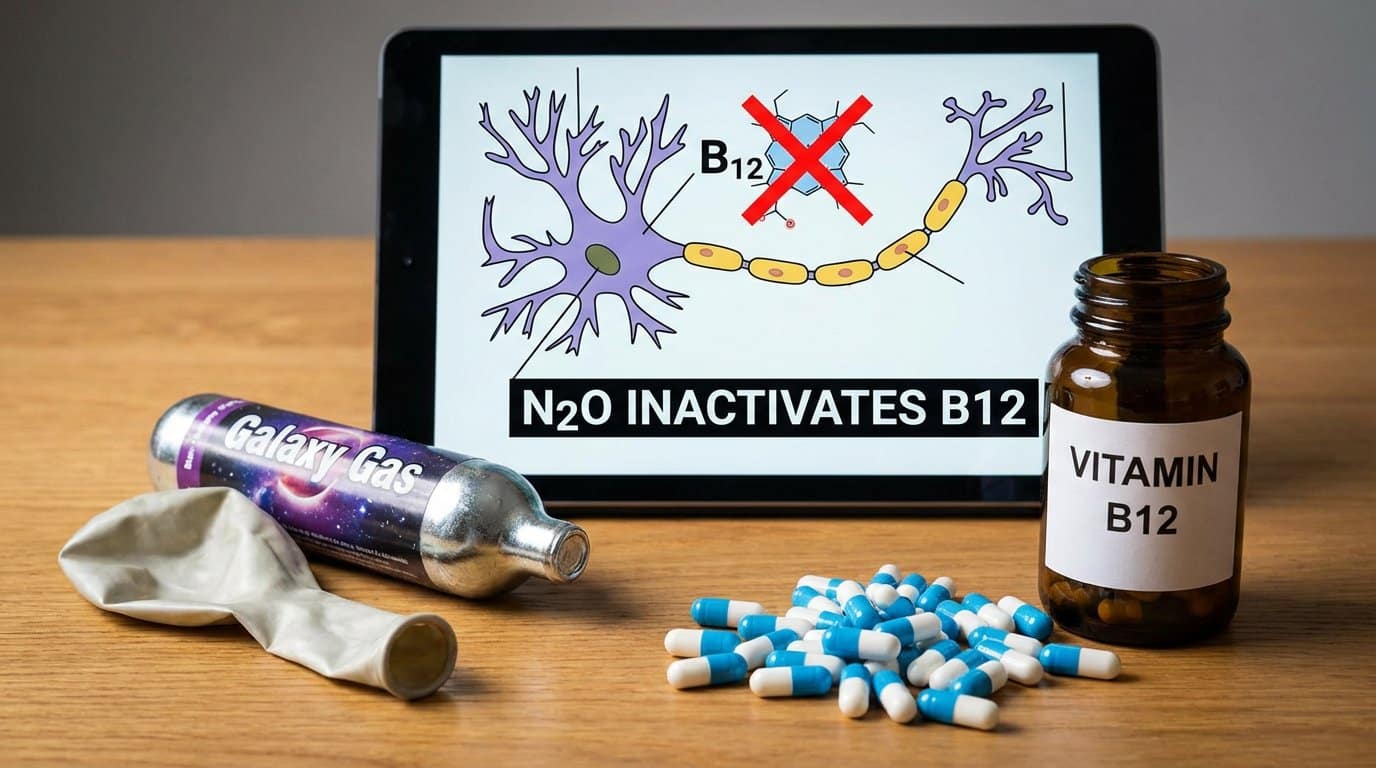
Every time you inhale galaxy gas, you’re triggering an irreversible chemical reaction that destroys vitamin B12, the essential nutrient your nervous system depends on for survival. Nitrous oxide oxidizes B12’s cobalt center, rendering the vitamin completely inactive. This inactivation halts myelin synthesis and disrupts DNA repair mechanisms in neural tissue.
What does galaxy gas do to you at the cellular level? It leaves your nerves unprotected. Without functional B12, myelin sheaths deteriorate, slowing signal transmission throughout your spinal cord and peripheral nerves. Homocysteine accumulates, causing vascular injury to neural structures. The risks of galaxy gas addiction extend beyond cognitive decline; it can lead to severe mood disturbances and a higher susceptibility to anxiety disorders. As the body struggles to maintain homeostasis, the fallout affects overall health, making even simple tasks feel overwhelming.
The damage compounds with each use. Subacute combined degeneration develops as your spinal cord’s white matter breaks down. Early B12 supplementation may reverse some symptoms, but prolonged deficiency creates permanent neurological deficits that persist long after exposure stops.
When Casual Use Becomes Permanent Brain Damage
Beyond B12 depletion, repeated nitrous oxide exposure initiates structural brain changes that mark the shift from recreational use to lasting neurological injury. You’re not just temporarily altering brain chemistry, you’re reshaping neural architecture with each session.
Oxygen deprivation damages your orbitofrontal cortex, reducing gray matter volume and disrupting executive function. Your white matter tracts deteriorate, slowing communication between brain regions. These changes compound with continued use.
Key neurological consequences of repeated exposure:
- Reduced gray matter volume in your orbitofrontal and medial temporal cortex
- Altered white matter integrity affecting neural signal transmission
- Persistent deficits in learning, memory, and processing speed
- Decreased dorsolateral prefrontal cortex activity during cognitive tasks
- Impaired decision-making from anterior insula dysfunction
Your brain can’t distinguish “casual” from chronic when hypoxia occurs repeatedly. Each episode accelerates cumulative damage.
Can Your Brain Recover After Galaxy Gas Abuse?
How quickly you seek treatment after stopping Galaxy Gas determines whether your brain can repair itself or sustain permanent damage.
Your neurons can begin recovering once oxygen levels normalize and nitrous oxide clears your system. Layer 5 neurons in the cingulate cortex demonstrate reactivation capacity, indicating neuroplasticity remains possible. Myelin sheath regeneration occurs when vitamin B-12 supplementation restores depleted levels, reversing demyelination before it becomes permanent.
However, critical thresholds exist. Brain cells deprived of oxygen beyond four minutes suffer irreversible death. Untreated subacute combined degeneration of the spinal cord causes lasting disability. Chronic B-12 depletion leads to permanent cognitive decline and paralysis.
Your recovery prognosis depends on intervention timing. Early medical evaluation, B-12 supplementation, and sustained abstinence allow your nervous system to repair without ongoing chemical interference.
How to Get Help for Galaxy Gas Addiction
Because nitrous oxide’s legal availability as a food-grade propellant obscures its addictive potential, many users don’t recognize when recreational use has crossed into dependency. Tolerance develops rapidly, requiring escalating doses to achieve euphoric effects while compounding neurological damage.
Effective treatment addresses both physiological and psychological components:
- Medical detox provides 24/7 monitoring for withdrawal symptoms and vitamin B12 supplementation to support nerve regeneration
- Cognitive behavioral therapy targets compulsive use patterns and develops alternative coping mechanisms
- Trauma-informed counseling addresses underlying conditions driving dependency
- Intensive outpatient programs maintain treatment continuity while preserving daily responsibilities
- Aftercare planning establishes relapse prevention strategies and ongoing support networks
You can access confidential guidance through SAMHSA’s National Helpline, available 24/7 for treatment referrals.
Don’t Let Nitrous Oxide Addiction Steal Another Day of Your Life
Nitrous oxide addiction can feel like a trap with no way out, but your story doesn’t end here. Florida Addiction Resource is here to help you find the right path forward by connecting you with trusted, licensed treatment providers across Florida who are fully committed to your recovery. No matter where you are in your journey, the help you need is closer than you think. Call us today at +1 (561) 562-4336 and let our team handle the rest.
Frequently Asked Questions
Does Mixing Galaxy Gas With Alcohol or Other Drugs Increase Brain Damage Risk?
Yes, mixing Galaxy Gas with alcohol dramatically increases your brain damage risk. Alcohol deepens respiratory depression, amplifying hypoxia that kills oxygen-starved hippocampal neurons within minutes. You’re also accelerating vitamin B12 depletion, alcohol impairs absorption while nitrous oxide inactivates it, speeding demyelination of your nerve fibers. This combination disrupts GABA and opioid pathways synergistically, intensifying neurotoxic effects. You’ll experience faster onset of numbness, memory deficits, and potentially irreversible spinal cord damage.
Can Galaxy Gas Abuse Trigger Seizures in People Without Epilepsy?
Yes, you can experience seizures from Galaxy Gas abuse even without epilepsy. When you inhale nitrous oxide repeatedly, you deprive your brain of oxygen, triggering hypoxia. This oxygen deprivation disrupts normal neuronal activity in your cerebral cortex, causing abnormal electrical discharges that manifest as seizures. You’re particularly vulnerable during high-dose sessions or enclosed-space use, where rapid oxygen depletion can induce loss of consciousness followed by seizure activity within minutes.
How Does Age Affect Vulnerability to Galaxy Gas Neurological Damage?
Your developing brain faces heightened vulnerability to Galaxy Gas damage because neural pathways haven’t fully matured. You’ll deplete vitamin B12 faster than adults due to higher metabolic demands, accelerating nerve demyelination. Your hippocampal neurons, essential for memory, show greater sensitivity to oxygen deprivation, increasing cell death risk. You’re more likely to develop peripheral neuropathy, cognitive impairments, and white matter deterioration. These age-specific factors mean neurological damage occurs faster and often proves irreversible.
Are the Psychological Effects of Galaxy Gas Similar to Other Inhalants?
Yes, Galaxy Gas shares psychological effects with other inhalants. You’ll experience dissociation, euphoria, and altered perception similar to solvents like nail polish remover or markers. However, Galaxy Gas affects your brain through distinct pathways, it depletes vitamin B12 and disrupts neurotransmitter systems rather than causing direct cellular toxicity. You’re also at risk for psychological dependence that mirrors addiction patterns seen with other inhalants, though the underlying neurological mechanisms differ considerably.
Can Brain Scans Detect Damage From Galaxy Gas Abuse?
Yes, brain scans can detect damage from galaxy gas abuse. MRI imaging reveals myelopathy and subacute combined degeneration in your spinal cord caused by B12 inactivation. You’ll also see evidence of nerve tissue deterioration and potential brain cell death from oxygen deprivation. Doctors use nerve conduction studies to measure peripheral neuropathy severity in your hands and feet. Early scanning identifies reversible changes, while chronic abuse shows permanent structural alterations.