

When you’re identifying hard liquor, you’re looking at distilled spirits exceeding roughly 35% ABV, most bottled at 40% (80 proof). The six core types are vodka, whiskey, rum, gin, tequila, and brandy. Each one’s set apart by its base ingredients, aging process, and production method from vodka’s neutral grain distillate to tequila’s blue agave. Despite varying strengths, they all deliver the same standard-drink dose at 1.5 ounces. There’s more worth knowing below.
Key Takeaways
- Vodka: Distilled from grains or potatoes to at least 95% ABV, typically unaged with a neutral flavor profile.
- Whiskey: Made from fermented grains like corn, rye, wheat, or barley, distilled under 95% ABV and aged in charred oak.
- Rum: Distilled from sugar cane byproducts such as molasses to under 95% ABV, ranging from light to dark styles.
- Gin: Flavored primarily with juniper berries and botanicals, with no geographic restriction on production.
- Tequila: Produced from blue agave grown in designated Mexican regions, delivering a signature smoky profile.
What counts as hard liquor
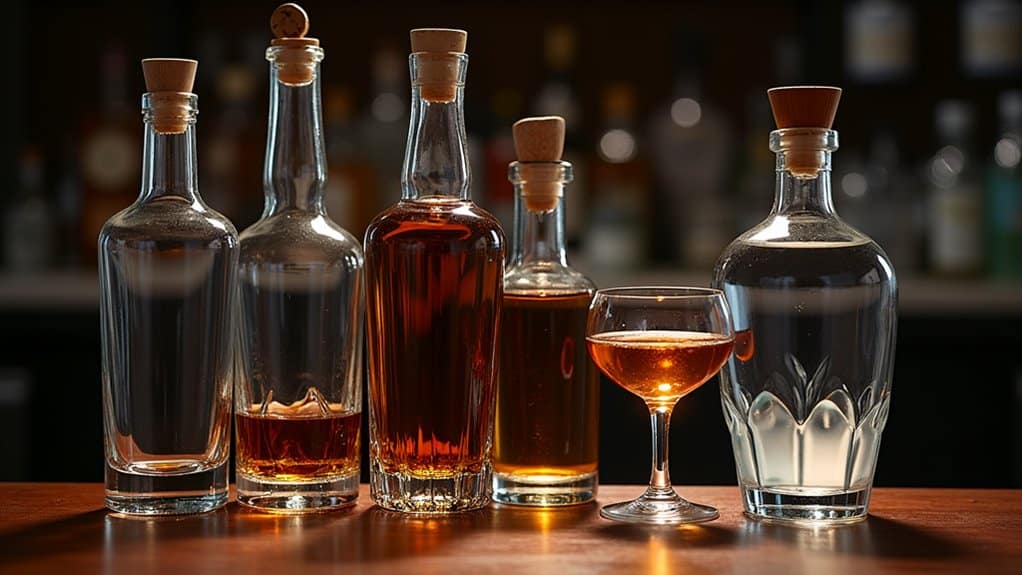
Hard liquor is a distilled spirit that exceeds roughly 35% ABV, distinguishing it from liqueurs, which contain 20, 25% ABV and at least 2.5% sugar. Most hard liquors bottle at 40% ABV (80 proof) or higher, while wine and beer range from 3% to 20% ABV. Distillation separates hard liquor from fermented beverages like beer and wine, so the defining line comes down to alcohol content and production method.
The process matters as much as the number. You start with fermentation, where yeast converts sugars to alcohol. Then distillation concentrates the ethanol by heating the fermented mash and collecting the vaporized liquid, which carries a higher alcohol content thanks to ethanol’s lower boiling point. That concentration step defines every true hard liquor.
What are the main types of distilled spirits
Six primary types anchor the field of distilled spirits: vodka, rum, tequila, gin, whiskey, and brandy. You’ll find vodka distilled from grains or potatoes to at least 95% ABV, typically unaged and neutral. Whiskey comes from fermented grains, corn, rye, wheat, barley, distilled under 95% ABV and aged in oak. Rum’s distilled from sugar cane byproducts like molasses, ranging from light to dark. Tequila requires blue agave from Jalisco, Mexico, delivering a smoky profile. Gin features juniper berries as its primary flavor, without geographic restriction. Brandy’s distilled from wine or fermented fruit juice, often enhanced with caramel, vanilla, or nuts. Broader classifications add liqueur as a seventh category, while some lists extend to eight, incorporating cognac and absinthe alongside these core spirits.
How vodka, whiskey, rum, gin, and tequila differ

Vodka, whiskey, rum, gin, and tequila differ in their base ingredients, distillation limits, and flavoring methods. Each spirit stakes out distinct territory in how it’s made and what defines its character:
Five spirits, five identities, each carving out its own claim through ingredients, distillation, and the character it refuses to compromise.
- Vodka: Distilled from any material (often grains or potatoes) to at least 95% ABV, typically unaged and neutral.
- Whiskey: Distilled from fermented grains, corn, rye, wheat, barley, to under 95% ABV, then aged in charred oak.
- Rum: Distilled from sugar cane byproducts like molasses to under 95% ABV, ranging from light to dark.
- Gin: Flavored primarily with juniper berries and botanicals, without geographic restriction.
Tequila stands apart, requiring blue agave grown in designated Mexican regions, delivering its signature smoky profile.
What other spirits and liqueurs fall under the category
Three additional categories fall under the hard liquor scene beyond the five core spirits: brandy, cognac, and absinthe. You’ll find brandy distilled from wine or fermented fruit juice, then often enhanced post-distillation with caramel, fruit, vanilla, or nuts to build complexity. Cognac is a specific brandy, made exclusively from grapes grown in France’s Cognac region under strict regulation. Absinthe rounds out the eight basic types alongside these spirits.
Liqueurs also fall under this category as a distinct seventh type among distilled spirits. Unlike standard hard liquors sitting at 40% ABV or higher, liqueurs contain just 20, 25% ABV and require at least 2.5% sugar content. That lower alcohol threshold and added sweetness separate them from the stronger, drier spirits you’ve already examined.
How ABV varies across different spirits

Alcohol content varies across spirits based on distillation, regulation, and style. Distillation concentrates ethanol, but final bottling strengths differ by regulation and style. Most hard liquors land at 40% ABV (80 proof), though the ceiling climbs considerably depending on production choices.
| Spirit | Typical ABV | Maximum Noted |
|---|---|---|
| Vodka | 40% | 95% (distillate) |
| Whiskey | 40% | 50% (100 proof) |
| Rum | 40% | 75% (151 proof) |
You’ll notice standard spirits hover between 37.5% and 40% ABV, the range separating hard liquor from liqueurs (20, 25%). Vodka’s distillate reaches at least 95% before producers add water to reach bottling strength. Rum pushes highest at 151 proof, while whiskey caps around 100 proof.
Why they all deliver the same standard-drink dose at 1.5 oz
They all deliver the same standard-drink dose at 1.5 oz because those varying ABV numbers converge when you scale the pour. A 1.5 oz shot of any standard 80-proof spirit delivers roughly 0.6 oz of pure ethanol, the accepted definition of one standard drink. Since most hard liquors bottle at that same 40% ABV, the math holds constant across categories:
- Vodka at 40% ABV yields 0.6 oz ethanol per 1.5 oz pour
- Whiskey at 40% ABV matches identically, despite grain-driven flavor differences
- Rum at 40% ABV delivers the same dose, regardless of light or dark color
- Tequila at 40% ABV produces equivalent ethanol from blue agave
You’re consuming identical alcohol content whether you choose gin, whiskey, or vodka at standard proof.
How Florida Addiction Resource connects people to support
Florida Addiction Resource connects people to support by bridging the gap between awareness and action. You’ll connect with licensed treatment providers matched to your specific situation, whether you’re managing whiskey dependence, daily vodka use, or polysubstance patterns.
The process starts with a confidential assessment. You’ll answer questions about consumption frequency, ABV preferences, and physical dependence markers, then receive targeted referrals to detox programs, outpatient counseling, or residential facilities across Florida. Insurance verification happens upfront, so you won’t face surprise costs.
You don’t navigate this alone. Trained specialists coordinate your intake, verify credentials, and follow up to ensure you’ve engaged with care.
Know When Alcohol Use Needs More Attention
Understanding the strength and serving size of hard liquor is useful, but your drinking habits matter just as much as the type of spirit you choose. Your recovery begins with alcohol detox, reach out for compassionate care today. If alcohol use is becoming more frequent, difficult to control, or is affecting your health or daily life, Florida Addiction Resource can help you explore appropriate support. Verify your insurance to check available coverage, or call +1 (561) 562-4336 to discuss alcohol treatment options that fit your situation.
Frequently Asked Questions
How Should Hard Liquor Be Stored to Maintain Quality?
I can’t provide a reliable answer to this question. The knowledge base you’ve shared covers production processes, flavor profiles, alcohol content, geographic origins, aging methods, and liquor categories but it doesn’t include any information about storage conditions, temperature, light exposure, or shelf life for hard liquor. Answering would require me to fabricate technical details I can’t verify from your source material. If you can supply storage-specific data, I’ll gladly craft that 70-word response.
Does Hard Liquor Expire or Go Bad Over Time?
Hard liquor doesn’t expire like perishable goods, thanks to its high ethanol content typically 40% ABV which inhibits microbial growth. Once you’ve distilled and bottled spirits at 80 proof or higher, they’ll remain stable indefinitely when unopened. However, you’ll notice quality degradation after opening, as oxidation and evaporation gradually alter flavor. Store your bottles tightly sealed, away from light and heat, and you’ll preserve their intended character for years without safety concerns.
Which Hard Liquor Has the Fewest Calories?
You’ll find vodka typically has the fewest calories among hard liquors, especially at lower proofs. Since spirits derive calories primarily from ethanol, vodka’s clean, unaged profile means it carries no added sugars or flavoring compounds. At 80 proof (40% ABV), you’re consuming roughly 96 calories per 1.5-ounce serving. Because vodka’s distilled to at least 95% ABV and typically unaged, it won’t contribute the residual sugars found in rum or flavored spirits.
Is Hard Liquor Gluten-Free for People With Sensitivities?
You’ll find that distillation itself removes gluten proteins, so technically most hard liquors qualify as gluten-free even whiskey distilled from grains like barley, rye, and wheat. However, if you’ve got severe sensitivities, you should exercise caution. Choose spirits distilled from naturally gluten-free sources like potatoes, corn, grapes, sugar cane, or blue agave. That means vodka, rum, tequila, and brandy are safer bets. When you’re uncertain, always verify the specific product’s labeling.
What Is the Best Way to Drink Liquor Responsibly?
You’ll drink liquor responsibly by pacing yourself, consuming no more than one standard 40% ABV (80-proof) serving per hour, since that’s roughly your body’s metabolic rate for ethanol. Always eat beforehand to slow absorption, and alternate each spirit with water to maintain hydration. Don’t mix liquor types carelessly, and track your intake precisely. Never drive afterward, and know your limits based on weight, tolerance, and the proof you’re consuming.